
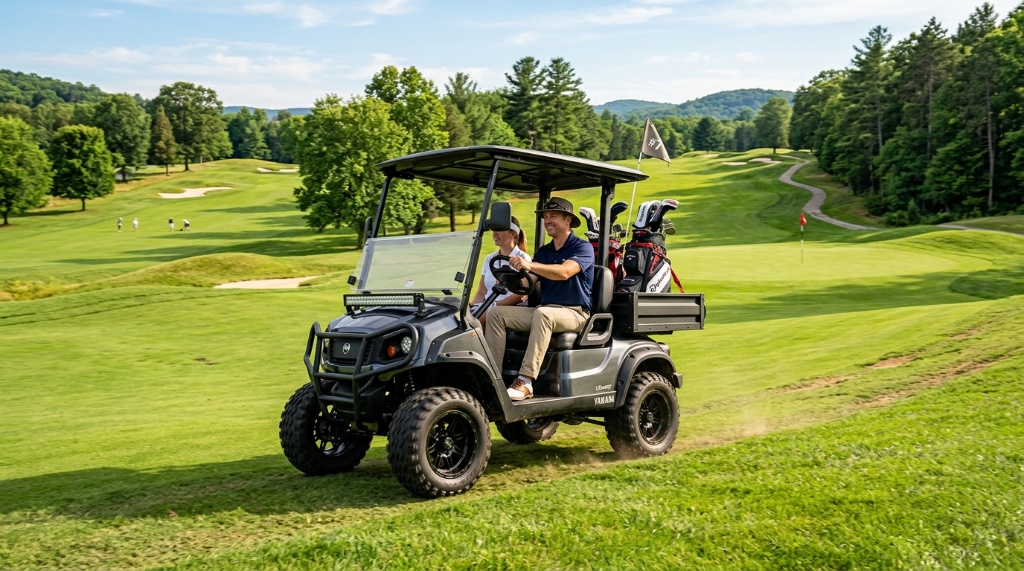
A standard golf cart handles a manicured fairway just fine. But add morning dew, a steep incline, or a path that transitions from pavement to gravel to wet grass, and suddenly that same cart feels like it’s working against you. All-terrain golf carts solve this problem by combining wider tires, higher ground clearance, and more capable suspension into a platform built for inconsistent surfaces. If you want to see how one specific model addresses these challenges in real conditions, check this review of a cart designed for exactly that purpose. This article explains what all-terrain carts actually change about mobility, where they help most, and what trade-offs you should know before buying one.
Quick Answer
All-terrain golf carts improve mobility by using larger, treaded tires, increased ground clearance, and more robust suspension to maintain traction and stability on grass, gravel, dirt, and slopes that would slow or stop a standard cart. The result is fewer stuck wheels, less turf damage, smoother rides over uneven ground, and access to areas of the course or property that conventional carts cannot safely reach.
Key Takeaways
- All-terrain carts primarily improve traction, stability, and clearance, not speed or range.
- Tire design and ground clearance matter more than motor size for most real-world mobility problems.
- These carts are especially useful on hilly courses, in wet conditions, and on mixed-surface paths.
- Trade-offs include higher cost, more turf impact if driven aggressively, and potentially lower top speed.
- Matching the cart’s tire and suspension setup to your actual terrain is more important than buying the most aggressive option available.
What Actually Makes a Golf Cart “All-Terrain”?
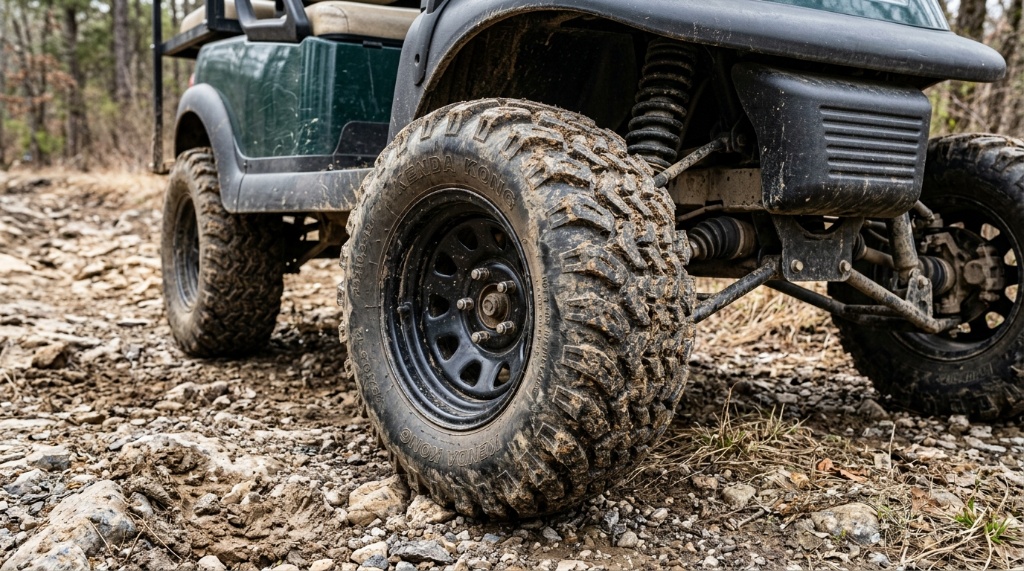
An all-terrain golf cart is not simply a standard cart with a lift kit. The meaningful differences come down to four systems working together: tires, suspension, ground clearance, and drivetrain configuration. Each one addresses a specific problem you encounter when the ground beneath you is not smooth or dry.
Tires are the most visible change. All-terrain carts typically use wider, taller tires with a more aggressive tread pattern than the turf-friendly, low-profile tires on standard carts. This tread bites into loose gravel, damp grass, and packed dirt instead of spinning. The wider footprint also distributes weight over a larger area, which reduces sinking on soft ground, To complement your mobility setup on the course, make sure to read our guide on select lightweight cart golf bags for comfortable play.
Ground clearance is the second critical factor. Standard golf carts often sit low to the ground, which is fine on flat fairways but becomes a liability when you cross a rutted path, a drainage swale, or a curb transition. All-terrain models raise the chassis enough to clear these obstacles without scraping the undercarriage.
Suspension upgrades matter more than many buyers expect. Better shocks and springs keep the wheels in contact with uneven ground, which maintains traction and reduces the jarring that passengers feel. On a course with rolling terrain or exposed roots, this difference is immediately noticeable.
How All-Terrain Carts Handle Specific Course Conditions
The practical value of an all-terrain cart shows up in specific situations. Here is how the design changes translate into real mobility improvements.
Wet Grass and Morning Dew
Standard turf tires are designed to minimize grass damage, which means they prioritize a smooth ride over grip. On wet grass, especially on slopes, those tires can lose traction. All-terrain tread patterns channel water away and provide more biting edges, so the cart maintains grip on dew-covered fairways and shaded areas that stay damp longer.
Gravel and Cart Path Transitions
Many courses have sections of gravel, crushed stone, or dirt paths connecting paved areas. Standard carts tend to skid or struggle on loose gravel, particularly when starting from a stop or turning. The larger contact patch and deeper tread of all-terrain tires handle these transitions without drama.
Hills and Slopes
On hilly courses, traction is only part of the equation. Stability matters too. A wider wheelbase and higher ground clearance allow the cart to approach steeper angles without bottoming out or feeling tipsy. The suspension also keeps the cart more level, which improves passenger confidence and reduces fatigue.
Rough or Unpaved Areas
Some courses have practice areas, maintenance paths, or peripheral zones that are not manicured. All-terrain carts can navigate these areas safely, which is useful for staff, for players who park in remote lots, or for anyone who needs to move between the clubhouse and a distant starting hole.
All-Terrain vs. Standard Golf Carts: What Changes
The table below summarizes the practical differences between a standard golf cart and an all-terrain model. These are general tendencies rather than absolute rules, since specific models vary.
| Factor | Standard Golf Cart | All-Terrain Golf Cart |
|---|---|---|
| Tire type | Smooth, turf-friendly | Treaded, wider profile |
| Ground clearance | Lower | Higher |
| Suspension | Basic | Upgraded shocks and springs |
| Traction on wet grass | Limited | Improved |
| Performance on gravel | Poor to fair | Good |
| Turf impact | Low | Higher if driven aggressively |
| Ride comfort on rough ground | Firm | Smoother |
| Typical cost | Lower | Higher |
The trade-off is straightforward: all-terrain capability costs more and requires more responsible driving to avoid damaging turf. If your course is flat, dry, and well-maintained, a standard cart may be entirely sufficient. If it is not, the upgrade pays for itself in usability.
Mobility Benefits That Go Beyond Traction
Traction is the headline benefit, but all-terrain carts improve mobility in other ways that matter over the course of a round.
Reduced physical strain is one. When a cart struggles on a slope or gets stuck, the driver has to compensate, often by reversing, repositioning, or pushing. Over 18 holes, that adds up. A cart that maintains grip and clearance reduces these interruptions.
Access to more of the course is another. Some players prefer to park closer to their ball rather than walking long distances from a paved path. An all-terrain cart can safely leave the path in more situations, which speeds up play and reduces walking distance, particularly for players with mobility limitations.
Passenger comfort also improves. Better suspension means less bouncing, which matters for older players or anyone with back or joint issues. A smoother ride is not just a luxury; it can be the difference between playing comfortably and cutting a round short.
Important Limitations and Trade-offs
All-terrain carts are not universally better. Several limitations are worth understanding before you buy or recommend one.
Turf damage is the most significant concern. Aggressive tread and heavier weight can tear up soft fairways if the cart is driven carelessly. Many courses restrict where all-terrain carts can go for this reason. If you plan to use one on a golf course, check the course’s policy first.
Cost is another factor. All-terrain models typically carry a higher purchase price and may require more expensive replacement tires. Maintenance on suspension components adds to long-term ownership costs.
Speed and range can be affected. Larger tires can change the effective gear ratio, and the added weight of upgraded components may reduce range slightly on electric models. Some all-terrain carts are also governed to lower top speeds for safety.
Finally, all-terrain capability is not a substitute for judgment. A cart that can handle rough ground still should not be driven on steep slopes, through deep mud, or across terrain it was not designed for. The improvements are incremental, not unlimited.
How to Choose the Right All-Terrain Setup
The best all-terrain cart for your situation depends on where you actually drive. Here is a practical way to decide.
- Identify your worst terrain. Is it wet grass, gravel, hills, or a mix? The answer determines how aggressive your tire and suspension setup needs to be.
- Check course rules. Some courses prohibit all-terrain carts or restrict them to certain areas. Confirm before you buy.
- Prioritize ground clearance if you cross curbs or ruts. Clearance prevents undercarriage damage and stuck situations.
- Prioritize suspension if comfort matters. If you or your passengers have back issues, upgraded suspension is worth the cost.
- Do not over-buy. A cart with massive tires and a lift kit is overkill for a flat, well-maintained course and will cause more turf damage than it solves.
If you are considering a specific model, look for independent reviews that describe real-world performance rather than just specifications. The way a cart handles on actual terrain is more informative than a list of features.
Frequently Asked Questions
Are all-terrain golf carts allowed on all golf courses?
No. Many courses restrict all-terrain carts because their tread patterns can damage turf. Always check with the course before using one. Some courses allow them only on certain paths or in dry conditions.
Do all-terrain tires damage grass more than standard tires?
They can, especially when the ground is soft or when the cart is driven aggressively. Wider, treaded tires distribute weight differently and can tear turf on turns or acceleration. Responsible driving reduces the risk significantly.
Can I convert a standard golf cart into an all-terrain cart?
Yes, lift kits, larger tires, and suspension upgrades are available for many standard carts. However, the results depend on the cart’s original design. A conversion may not match the performance of a cart built from the ground up for all-terrain use.
Do all-terrain golf carts go faster than standard carts?
Usually not. Many are governed to similar or lower top speeds for safety. The benefit is traction and stability, not speed. Larger tires can actually reduce effective torque if the gearing is not adjusted.
Are all-terrain golf carts good for players with mobility issues?
They can be. The smoother ride and ability to navigate uneven ground make them more comfortable and accessible for players who have difficulty walking long distances or who need a stable platform. However, getting in and out of a lifted cart may be harder for some users.
What is the most important feature of an all-terrain golf cart?
For most users, tires and ground clearance matter most. Tires determine traction, and clearance determines what obstacles the cart can cross without scraping. Suspension improves comfort and wheel contact but is secondary to those two factors.
Conclusion
All-terrain golf carts improve mobility by addressing the specific ways standard carts fail: poor traction on wet or loose surfaces, low clearance over uneven ground, and firm rides that make rough terrain uncomfortable. The benefits are real, but they come with trade-offs in cost, turf impact, and sometimes speed. The right choice depends on where you actually drive and what rules apply at your course. If your terrain is challenging, an all-terrain cart can make the difference between a frustrating round and a smooth one. If it is not, a standard cart remains the simpler and more economical option.


