
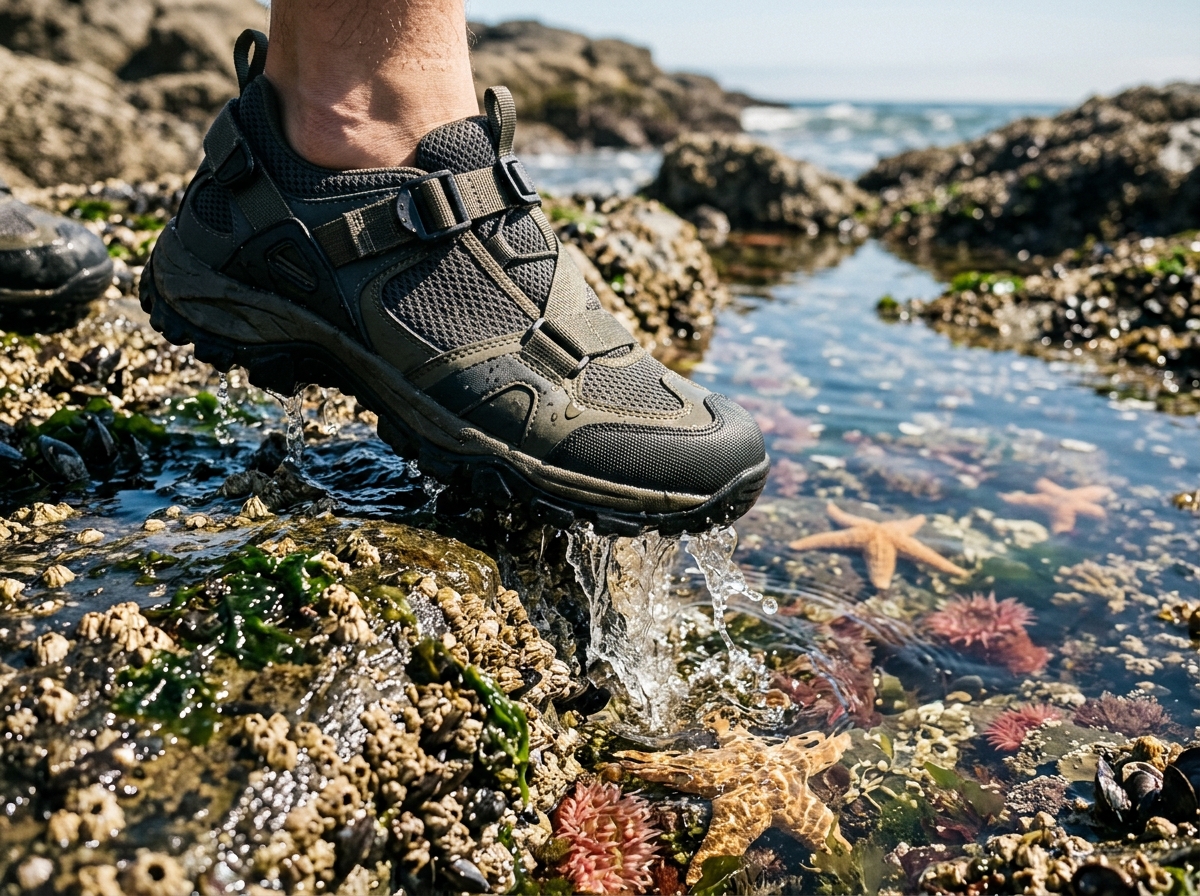
You step onto a wet reef shelf, and the surface feels like greased glass. One wrong step can mean a sliced toe from live coral or a nasty fall onto rock. The right footwear changes that outcome entirely. Most people assume any pair of water shoes will hold up, but tide pools and reefs are uniquely punishing environments. If you’ve been comparing options and wondering whether men’s surfing shoes can double as reef-walkers, the answer depends on construction details most buyers overlook. Here’s what actually matters before you buy.
Quick Answer
For tide pools and reefs, prioritize three things: a sticky rubber outsole with a defined tread pattern, a closed protective toe and heel, and quick-draining uppers made from abrasion-resistant materials. Flat, thin-soled “aqua socks” offer almost no protection against coral and rock. For the best balance of grip, drainage, and durability, look for shoes designed for surfers and reef walkers rather than general pool or beach use.
Key Takeaways
- Grip and protection matter more than cushioning in reef environments; a sticky rubber compound with deep lugs outperforms soft, smooth soles on wet rock.
- Closed-toe designs with reinforced toe caps and heel counters prevent cuts and stubbed toes from coral and uneven rock.
- Drainage and quick-drying materials reduce weight, blisters, and the risk of bacterial issues during long walks.
- Fit matters more than you think; a snug but not tight fit keeps feet stable when wet and prevents sliding on descents.
- No water shoe is fully puncture-proof, so step carefully even in durable footwear.
Why Reef and Tide Pool Environments Destroy Ordinary Footwear
Tide pools and reefs combine everything that wears shoes down: sharp calcium carbonate structures, wet and often slimy rock surfaces, sand that works into seams, and constant salt exposure. That combination attacks different parts of a shoe simultaneously.
Fabrics break down from salt and UV exposure. Stitching fails when sand grains work into seams and abrade the threads. Rubber softens or hardens depending on compound quality. Adhesives weaken with repeated wet-dry cycles.
A shoe that works fine for a pool deck or a sandy beach walk may fall apart or cause injury after a few reef outings. This is why the criteria for this environment differ from general water shoe buying advice.
What Actually Matters When Choosing Reef-Ready Water Shoes
Grip: The Single Most Important Feature
Wet, algae-coated rock is the most dangerous surface you’ll encounter. A shoe’s grip depends almost entirely on the rubber compound and the tread geometry.
Soft, sticky rubber compounds conform better to uneven surfaces and grip wet rock more effectively than hard, durable compounds. That’s why many surf-specific shoes use rubber formulations similar to high-performance surf traction pads. However, softer rubber wears faster. This is the central trade-off in reef footwear: stickier rubber usually means a shorter lifespan, especially on abrasive surfaces.
Look for:
- A rubber compound described as sticky or high-friction, not just durable
- Tread with siping (small cuts or grooves) that channels water away from the contact surface
- Multi-directional lugs, not just simple horizontal lines
- Adequate tread depth; a completely flat sole offers less grip on uneven, wet terrain
Protection: Closed Toe, Reinforced Heel, Puncture Resistance
Open-toe water shoes are fine for sandy beaches but risky on reefs. Live coral, urchin spines, sharp rock edges, and broken shell fragments can cause serious cuts or puncture wounds.
Key protection features:
- Closed toe with a rubber toe cap that extends upward, not just a thin fabric layer
- Reinforced heel counter to protect against scrapes and keep the foot stable
- Thicker sole construction (typically 4–8mm in serious reef shoes) to provide some puncture resistance
- High-cut or mid-cut designs for ankle protection when navigating uneven rock
No water shoe is fully puncture-proof. Sea urchin spines and sharp coral can penetrate even thick soles. Protection reduces risk; it does not eliminate it.
Materials and Construction: What Survives Salt and Sand
Materials determine how long the shoe lasts and how quickly it dries. In tropical environments, drying speed affects both comfort and hygiene.
- Neoprene provides warmth and a snug fit, which suits surfers and cold-water use. It absorbs some water and dries more slowly than synthetic mesh.
- Polyester or nylon mesh drains quickly and dries fast, making it ideal for warm-water reef walking. It offers less warmth and less structural support.
- Rubber or synthetic leather overlays add durability and protection but may reduce breathability and drainage.
- Stitched and glued construction is standard, but look for reinforced stitching at stress points (toe, heel, strap anchors).
Sand works into seams and gradually wears thread. Reinforced, double-stitched seams last longer. Some designs use welded or fused seams to reduce this vulnerability.
Drainage and Weight
Water trapped inside a shoe adds weight with every step. Over a long walk on uneven terrain, that extra weight increases fatigue and the chance of a misstep.
Look for drainage ports in the sole and mesh panels in the upper. The faster water exits, the lighter and more comfortable the shoe stays. This matters less for a ten-minute dip and much more for a two-hour reef exploration.
Fit: Why It’s More Important Than You Expect
Wet feet slide inside wet shoes. A shoe that fits well when dry may feel loose in the water, causing blisters and instability on descents.
Choose a snug fit with no heel lift. The toe box should allow slight movement without the foot sliding forward on downhill terrain. Adjustable closures (laces, straps, or bungee systems) let you tighten the shoe as needed.
Avoid sizing up for growth or comfort; in this environment, a loose shoe is a liability rather than a comfort feature.
A Comparison Table: Types of Water Shoes for Reefs
| Type | Grip | Protection | Durability | Best For |
|---|---|---|---|---|
| Aqua socks/pool shoes | Low to moderate | Minimal | Low | Sandy beaches, pool decks |
| Reef walkers/water sandals | Moderate to high | Moderate | Moderate | Shallow reefs, tide pools |
| Surf-specific shoes | High | Moderate to high | Moderate to high | Rocky entries, reef breaks, long walks |
| Dive booties | Moderate | Moderate | Moderate | Cold water, wetsuit compatibility |
Surf-specific shoes often strike the best balance for reef and tide pool environments because they’re designed for wet, rocky entries and exits. They prioritize grip and drainage, and many include reinforced toe and heel protection. They also work well as general reef shoes when the fit is right.
Real-World Scenarios and What to Wear
Scenario: Exploring a shallow tide pool at low tide
You’re walking on wet rock with patches of algae, occasionally stepping into sandy pools. Protection needs are moderate; grip is critical. A low-cut water shoe with sticky rubber and a reinforced toe works well. Drainage matters because you’re in and out of water repeatedly.
Scenario: Crossing a reef flat to reach a surf break
You’re carrying a board or walking a long distance on uneven, sharp, wet terrain. Grip, protection, and secure fit all matter. A surf shoe or reef bootie with mid-cut ankle support is a better choice than a low-profile sandal or aqua sock.
Scenario: Snorkeling from shore over rocky bottom
You need enough protection to stand and walk on rock and coral rubble, plus drainage for swimming. A snug, lightweight water shoe or dive bootie with a grippy sole handles this well. Avoid anything loose that could come off in the water.
Common Mistakes to Avoid
- Buying aqua socks for reef use. They’re designed for sand and pool decks, not sharp coral or slippery rock.
- Prioritizing style over function. A trendy slip-on may look fine but lack the grip and protection you need.
- Ignoring fit when wet. Always consider how the shoe behaves in water, not just on dry land.
- Assuming all rubber soles are equally grippy. Compound softness and tread design vary widely.
- Skipping sun protection on exposed feet. Sunburn on the top of the foot is common and painful; shoes don’t cover everything.
How to Extend the Life of Your Water Shoes
Durability isn’t just about construction; care habits matter. Rinse shoes in fresh water after every saltwater use to remove salt crystals and sand. Dry them away from direct sunlight, which degrades rubber, neoprene, and adhesives. Store them loosely, not compressed, to avoid permanent creasing that can cause cracks.
Inspect stitching and sole edges periodically. Small separations can be repaired with appropriate adhesive before they become failures. Sand trapped in seams accelerates wear, so a quick rinse after each trip pays off over time.
Frequently Asked Questions
Can I use regular sneakers for tide pools instead of water shoes?
You can, but they drain poorly, become heavy, and offer minimal grip on wet rock. They also degrade quickly in saltwater. Water-specific shoes are safer and last longer in this environment.
Are surf shoes good for walking on reefs?
Often yes. Many surf shoes are designed for rocky, wet entries and provide excellent grip and toe protection. Check that the sole is thick enough for the terrain you’ll encounter and that the fit is secure.
How thick should the sole be for reef protection?
There’s no exact number, but thicker soles (roughly 4–8mm in durable designs) generally offer more puncture resistance than thin aqua-sock soles. Very thick soles can reduce ground feel and flexibility, so choose based on your terrain.
Do water shoes need to be waterproof?
Water shoes are designed to get wet, not to keep water out. They drain and dry quickly rather than preventing water entry. “Waterproof” in this context usually means the materials resist breakdown from water exposure, not that your feet stay dry.
How often should I replace reef water shoes?
Replace them when the outsole tread wears smooth, seams begin to separate, or the upper materials crack or tear. Salt and UV exposure accelerate wear, so inspect regularly if you use them often.
Are cheap water shoes worth it for tide pools?
Inexpensive shoes can work for light, sandy use but often lack the grip compound and construction needed for rocky or coral-heavy environments. If you’ll be on wet rock or sharp surfaces, spending more on a purpose-built shoe is usually worth it.
Conclusion
The right water shoes for tide pools and reefs come down to grip, protection, drainage, and fit. Prioritize sticky rubber with a functional tread, closed-toe protection, and materials that drain and dry quickly. Surf-specific shoes often hit the sweet spot for this kind of terrain. Match your choice to the specific environment you’ll be walking on, inspect your footwear regularly, and replace it when wear compromises safety. A thoughtful purchase now prevents a painful injury later.


