Walking into a pet store or scrolling through online listings for fish tank lighting can feel overwhelming. You see prices ranging from twenty dollars to several hundred, and every product claims to be the best. If you have ever wondered whether a lower-cost LED light can actually support healthy plant growth or simply bring out the colors of your fish, you are not alone.
Many hobbyists assume that affordable options are automatically inferior, but that is not the full story. The truth is that budget-friendly affordable aquarium LED lights fish tank lighting can deliver excellent results if you know what to look for. This guide will cut through the marketing hype and give you a practical framework for selecting the perfect light without breaking your budget.
What Makes an Aquarium LED Light Affordable Without Being a Waste of Money?
An affordable aquarium LED light is one that balances upfront cost with longevity, energy efficiency, and actual performance for your specific tank setup. Cheap lights often fail within months or lack the proper spectrum for plant growth.
To determine if a light is truly affordable, look at three factors: cost per watt, expected lifespan, and whether it includes a warranty or return policy. A $40 light that lasts three years and supports low-light plants is more affordable than a $30 light that dies in six months. Additionally, affordable does not mean stripped of features. Many budget LEDs now include adjustable brightness, timers, and even basic RGB controls. The key is to avoid lights that use outdated technology like T8 fluorescent tubes or very low-quality LED chips that produce a weak, uneven beam.
Hidden Costs of Ultra-Cheap Lights
If a light seems shockingly cheap, ask yourself what corners were cut. Inexpensive lights often lack proper heat sinks, causing LEDs to overheat and dim quickly. They may also use non-replaceable components, meaning you have to buy a whole new fixture when one diode fails. Factor in the cost of replacement and electricity over two years to get the real price.
Why Is Light Spectrum More Important Than Wattage for Plant Growth?
Spectrum determines whether your plants can photosynthesize effectively, while wattage only tells you about energy consumption. A light with high wattage but the wrong spectrum will grow algae and leave plants struggling.
Plants primarily use red (around 660nm) and blue (around 450nm) wavelengths for photosynthesis. White LEDs that mimic natural daylight usually contain a broad spectrum that covers these ranges adequately for low-to-medium light plants. If you plan to keep demanding species like carpeting plants or red stem plants, you need a light with dedicated red and blue diodes or a full-spectrum array that peaks in those areas. Many affordable lights now advertise “full spectrum,” but you should verify this by looking at the spectral graph if available. A light that appears very pink or purple to the eye often has too much red and blue and not enough green, making your fish look washed out.
Reading a Spectral Graph on a Budget
You do not need to be a scientist. Look for a graph that has two distinct peaks in the blue and red zones and a gradual dip in the green zone. If the graph is flat or only has one peak, the light is not truly optimized for plants.
How Many Lumens or PAR Do You Actually Need for Your Tank?
For low-light plants like Java fern and Anubias, aim for 10-20 lumens per liter or a PAR value of 20-30 at the substrate. For medium-light plants, target 20-40 lumens per liter or 30-50 PAR.
Lumens measure the total visible light output as perceived by the human eye, while PAR (Photosynthetically Active Radiation) measures the light actually usable by plants. Most budget light manufacturers list lumens but not PAR. As a rule of thumb, a light that produces 800-1200 lumens at a distance of 12 inches over a 20-gallon tall tank will support low-light plants. For a 40-gallon breeder tank, you need at least 2000-3000 lumens. If the manufacturer provides PAR readings at different depths, use those numbers instead, as they are much more accurate.
Quick Lumens per Gallon Guide
Here is a simple starting point for standard freshwater tanks using LED lights:
- Low light: 10-20 lumens per gallon (suitable for low-light plants only)
- Medium light: 20-40 lumens per gallon (good for most stem plants and swords)
- High light: 40+ lumens per gallon (requires CO2 injection to avoid algae)
Remember that tank depth is critical. A tall 55-gallon tank needs significantly more light than a shallow 40-gallon breeder with the same gallon rating.
Which Type of LED Light Fixture Is Best for a Beginner?
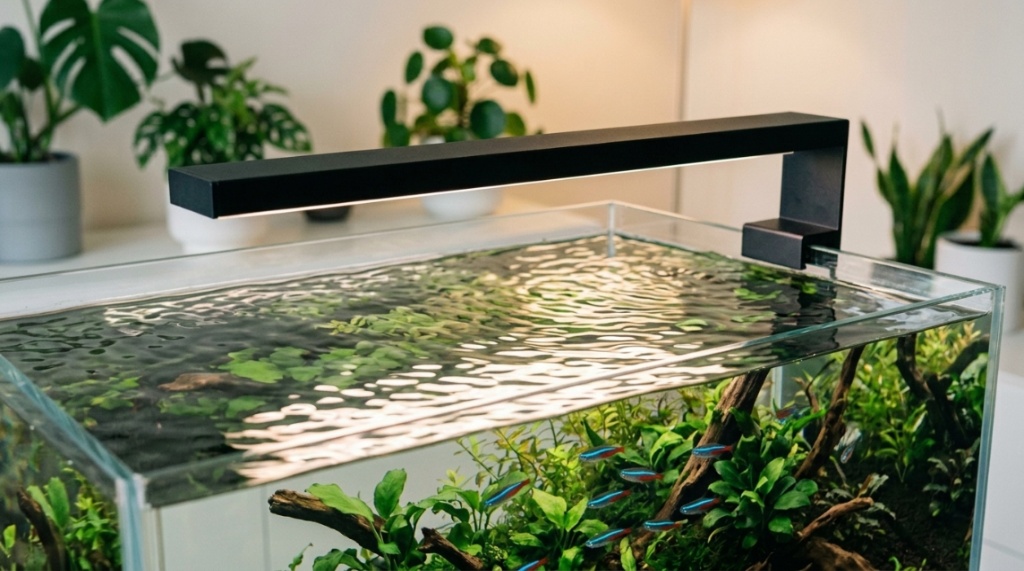
A clip-on or clamp-style LED light with a gooseneck arm is usually the most beginner-friendly and affordable option for small tanks under 20 gallons. For larger tanks, a full-length light bar that sits on the rim is ideal.
Clip-on lights are inexpensive, easy to position, and often come with adjustable heads. They work well for nano tanks and desktop aquariums. However, they tend to have limited coverage and may not spread light evenly across a wider tank. Full-length light bars provide even illumination across the entire tank surface, which is crucial for preventing dark corners where algae can grow. For tanks 30 inches or longer, avoid clip-on lights unless you use multiple units. A single bar light is generally more cost-effective and easier to manage.
Considerations for Different Tank Shapes
- Cube tanks: A single high-intensity clip-on light or a small pendant works well.
- Long rectangular tanks: Use a bar light that matches the tank length or slightly overlaps.
- Bowfront tanks: Look for a light with adjustable legs or a curved mounting bracket.
- Deep tanks: You need a light with higher PAR penetration, often requiring a more powerful model even in the budget range.
Can You Use a Low-Cost LED Light for a Planted Aquarium?
Yes, absolutely. Many budget-friendly LED lights are fully capable of supporting a thriving planted aquarium, provided you choose the right plants and manage your expectations regarding growth speed.
The most important factor is matching the light intensity to your plants. Low-tech, low-light plants like Java moss, Anubias, Cryptocoryne, and Vallisneria will grow perfectly under a basic full-spectrum LED that provides 20-30 lumens per liter. You do not need CO2 injection or expensive fertilization. Even medium-light plants like Hygrophila, Rotala rotundifolia, and Amazon swords can thrive under budget lights if you keep the light close to the water surface (within 12-18 inches). Avoid demanding carpeting plants like Monte Carlo or Dwarf Baby Tears unless you are prepared to upgrade your light and add CO2.
Example Setup for a 10-Gallon Planted Tank on a Budget
Use a clip-on LED rated at 300-500 lumens. Plant with Anubias nana, Java fern, and Crypt wendtii. Keep the light on for 8 hours per day. You will see steady, healthy growth without breaking the bank. This combination works reliably.
What Features Should You Prioritize in a Budget Aquarium Light?
Prioritize adjustable brightness, a built-in timer, and a low-profile design that fits your tank rim. These features directly impact the health of your aquarium and your daily convenience.
Adjustable brightness is the single most valuable feature for a budget light because it allows you to control algae growth. If you notice algae starting to bloom, simply dim the light for a few days. A timer ensures consistent photoperiods, which is essential for plant health and preventing fish stress. Without a timer, you might forget to turn the light off, causing algae outbreaks. Other nice-to-have features include separate channels for white and blue LEDs, which let you create a sunrise or sunset effect, and a splash-proof rating (IP65 or higher) to protect against humidity.
Features You Can Skip to Save Money
- Smartphone app control: Often buggy on cheap lights and adds at least $20 to the price.
- Moonlight mode: A novelty that rarely gets used after the first week.
- Built-in CO2 diffuser: These are usually low-quality and you are better off with a separate system.
- RGB color channels: Fun for visual effects but not essential for plant growth.
How to Compare Affordable Aquarium LED Lights Effectively
Create a shortlist based on tank size, desired plant type, and budget. Then compare three key metrics: PAR values at your tank depth, user reviews mentioning longevity, and warranty length.
Start by measuring your tank length and width. Write down the maximum height from light to substrate. Search for lights that are specifically designed for that dimension. Then, look for independent PAR testing videos or reviews. Many YouTube channels measure PAR using a quantum sensor. If you cannot find PAR data, read user reviews that mention plant growth results. Be wary of lights with a high number of five-star reviews if the reviews are vague or mention “looks nice” instead of “my plants grew well.” A 1-year warranty is the minimum you should accept for a light over $30. Lights under $20 rarely have a warranty, which is acceptable if you are willing to replace them.
Red Flags in Product Listings
- Claims of “high PAR” without providing actual numbers
- Images of lush planted tanks that clearly use high-end lighting
- No mention of wattage or lumens on the product page
- Very few reviews or reviews that are all from the same day
Which Brands Offer Reliable Affordable Aquarium LED Lights?
Hygger, Nicrew, and Beamswork are three brands that consistently produce reliable, budget-friendly LED lights for freshwater tanks. Each offers a range of models suitable for different tank sizes and plant needs.
Hygger lights often include features like adjustable brightness, timers, and dual channels, making them a favorite among planted tank enthusiasts on a budget. Nicrew lights are known for their slim profile and excellent coverage per dollar. Beamswork lights are slightly more basic but very durable and long-lasting. Other honorable mentions include Finnex Stingray (for low-light tanks) and Aqueon OptiBright (for standard community tanks). Avoid no-name brands with no customer support, as the risk of failure is high.
Quick Brand Comparison Table
| Brand | Best For | Typical Price Range | Key Feature |
|---|---|---|---|
| Hygger | Planted tanks (low-medium light) | $30 – $60 | Adjustable brightness and timer |
| Nicrew | General view and low-light plants | $25 – $50 | Slim profile, even coverage |
| Beamswork | Durability and basic use | $20 – $40 | Long lifespan, simple operation |
| Finnex | Low-tech planted tanks | $40 – $70 | PAR value is verified by community |
When Should You Upgrade from an Affordable Light to a Premium One?
You should upgrade when your plants show signs of insufficient light, such as stunted growth, leggy stems, or leaves turning pale, and you have already tried lowering the light closer to the water or increasing the photoperiod.
Another clear sign is if you want to keep high-light plants like Glossostigma or AR mini. These species need a PAR of 50+ at the substrate, which is difficult to achieve with budget lights in tanks deeper than 18 inches. If you are planning to add CO2 injection, you also need a light that can keep up with the increased growth demand. At that point, spending $100-200 on a quality light like a Finnex Planted+ or a Chihiros WRGB becomes a worthwhile investment. However, for the vast majority of hobbyists with low-tech tanks and undemanding plants, affordable aquarium LED lights fish tank lighting will serve you perfectly for years.
How to Set Up Your Budget LED Light for Maximum Plant Growth
Place the light as close to the water surface as possible without risking moisture damage, typically 2-4 inches above the rim. Run it for 8 hours initially, then adjust based on algae and plant response.
Start with a photoperiod of 8 hours per day. If you see algae within the first two weeks, reduce the photoperiod to 6 hours and lower the brightness if your light allows adjustment. If plants look healthy and no algae appears, you can slowly increase the photoperiod by 30 minutes each week until you reach 10-12 hours. Clean the light lens every two weeks because dust and salt creep can reduce light output by up to 20%. Also, ensure the light is level; an angled light can create uneven growth zones.
Signs Your Light Setting is Correct
- Plants show new growth within the first week
- Leaves are a vibrant green or red depending on the species
- No green hair algae or cyanobacteria on the glass or substrate
- Fish exhibit normal behavior and are not hiding from bright light
While choosing the right affordable aquarium LED lights is essential for plant growth and visibility, maintaining clean water is just as critical to prevent algae blooms. Pair your new lighting system with our comprehensive Guide to Aquarium Filters for Hassle-Free Maintenance to keep your tank crystal clear.
Conclusion
Choosing the best affordable aquarium LED lights for your fish tank is not about finding the cheapest option, but about matching the right features to your specific setup. You now know that spectrum matters more than wattage, that clip-on lights work well for small tanks, and that brands like Hygger and Nicrew offer excellent reliability without the high price tag. Remember to prioritize adjustable brightness and a timer, and always start with low-light plants if you are new to planted aquariums. The perfect light for your tank exists within your budget, and with the guidance in this article, you are well-equipped to make a confident purchase. Your fish and plants will thank you for the effort.
Frequently Asked Questions
Can I use a regular LED light bulb in my aquarium?
No, regular household LED bulbs are not designed for aquarium use. They lack the correct spectrum for plant growth, may not be waterproof, and can cause electrical hazards if they get wet. Always use lights specifically marketed for aquariums.
How long should I run my aquarium LED light each day?
Start with 8 hours per day for a planted tank and 6-8 hours for a fish-only tank. Adjust in 30-minute increments based on algae growth. Too much light causes algae, while too little stunts plant growth.
Do I need a timer for my aquarium light?
Yes, a timer is highly recommended. Consistent photoperiods help maintain a healthy biological rhythm for your fish and plants. Many budget lights now include a built-in timer, but you can also buy an external outlet timer for under $10.
Will a cheap LED light grow algae?
Any light, cheap or expensive, can grow algae if left on too long or if the intensity is too high for your tank. The key is to match the light output to your plants’ needs and maintain a consistent photoperiod. Algae usually indicates an imbalance, not a bad light.
Can I use an aquarium LED light for a terrarium or paludarium?
Yes, but only if the light is rated for high humidity (IP65 or higher). Many affordable aquarium lights work well for terrariums, but check the specifications, as some models are not sealed against moisture from above.
What is the best affordable light for a 20-gallon tall tank?
A Hygger HG-957 or Nicrew ClassicLED Gen 2 are excellent choices. Both provide sufficient PAR for low-to-medium light plants at a depth of 18-20 inches, and they include adjustable settings to fine-tune the output for your specific plants.
Do I need separate blue and white LED channels?
Not necessarily. A single full-spectrum channel is sufficient for most low-tech planted tanks. Separate channels offer more control over color temperature and can help reduce algae, but they add cost. For a true budget setup, a single-channel light with adjustable brightness is perfectly adequate.